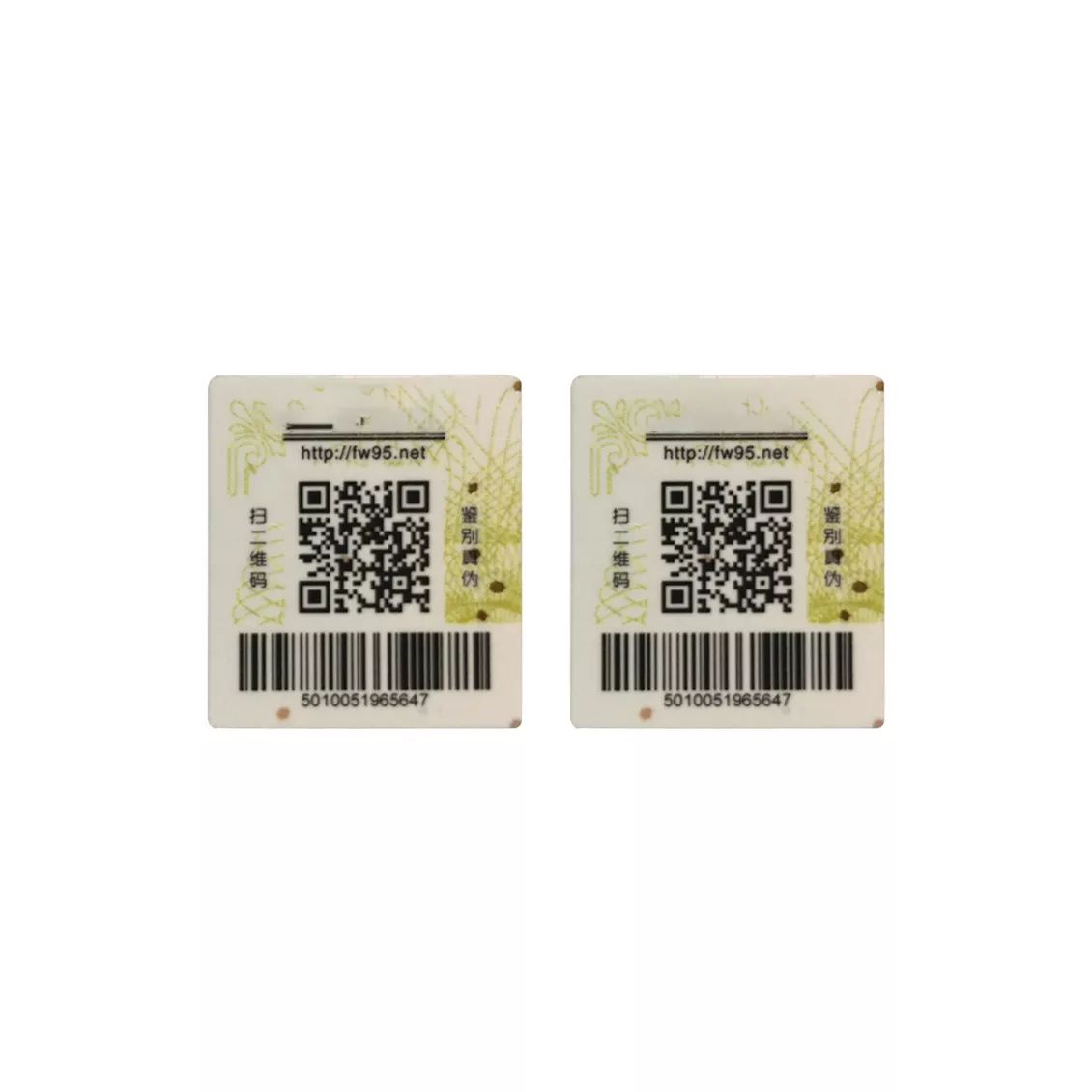
What Double Layer Labels Are and How They Work
A double layer label is a two-ply construction: a printed top layer sits over a second printed layer beneath it. The top layer peels away to reveal the information printed on the bottom layer. The lower ply stays on the product, so the hidden content remains readable after the top ply is removed.
This structure solves a common constraint in product security. A single-layer label has one visible face, and once that face is full there is nowhere else to put batch detail, verification instructions, serial numbers or a second authentication element. With a two-ply label, the same footprint carries two surfaces of content, so more information fits without a bigger label.
Because the top ply separates from the bottom ply, the construction also functions as a tamper-evident feature. Once the upper layer is lifted, it cannot be reapplied cleanly, which makes interference visible to the next person handling the product.
Two Layers, Twice the Content on One Footprint
The practical benefit of double layer labels is information density. The top ply typically carries the branding, product name and primary warning or authentication message. The bottom ply can hold the content you would rather not expose on the shelf: serial numbers, QR codes for verification, batch and date codes, care or handling instructions, or a second security feature such as a latent image.
This division matters for authentication workflows. A checker can be directed to peel the top layer only after a first-level check, adding a step that is difficult to replicate without the genuine construction. For more on how peel-based features compare with other overt and covert security formats, see our guide to tamper-evident versus tamper-proof versus void labels.
The two plies can also carry different security technologies. The top layer might be a straightforward printed film, while the bottom layer holds a latent image that only appears at a viewing angle, or a metal-particle element, or a laser-printed QR code with a serial number. This lets one label combine a visible deterrent with a covert check.
Constructions and Options
Double layer labels are specified by adhesive, finish, size and core, and each choice affects how the label performs on your line and on your product.
- Adhesive: permanent or removable. Permanent adhesive bonds the bottom ply firmly to the substrate. Removable adhesive suits applications where the label must come off without residue, such as temporary promotions or returnable packaging.
- Finish: matte or gloss. Matte reduces glare and suits labels that will be photographed or scanned. Gloss gives stronger contrast for brand graphics.
- Size: custom sizes are standard. Examples include 2x3 inch and 3x4 inch, and other dimensions can be quoted against your artwork.
- Core: 1 inch core, compatible with common applicator and printer setups.
- Packing: boxed or carton packing, agreed at order stage.
Several variants sit within this format. Double-layer latent-image labels hide a mark in the bottom ply that becomes visible at an angle. Metal-particle double-layer labels use a metallic element as a detectable feature. Laser QR serial double-layer labels combine a serialized QR code with the two-ply structure for track-and-trace programs.
If your application also requires a void message or a destructible film on removal, our tamper-evident label range covers those constructions and can be discussed alongside a two-ply design.
Model DL-01 at a Glance
| Item | Detail |
|---|---|
| Construction | Two-ply; top layer peels to reveal bottom-layer print |
| Adhesive | Permanent or removable |
| Finish | Matte or gloss |
| Size | Custom (examples: 2x3 inch, 3x4 inch) |
| Core | 1 inch |
| Packing | Boxed or carton |
| MOQ | 20,000 |
| Lead time | 7-14 days |
Manufacturing and Quality Background
These labels are produced by Shenzhen Huaxin Anti-Counterfeiting Technology Co., Ltd., a security label manufacturer in Shenzhen operating since 2008. The company runs a 1,500 m² factory with 60-100 employees and a monthly capacity of 510,000 to 1,000,000 labels. Its operations have been audited by TÜV Rheinland (report MIC-ASR262171), and it works with more than 60 anti-counterfeiting technologies.
That breadth of technology matters for double layer labels because the two plies can draw on different features. If your specification calls for a latent image on one ply and a serialized QR code on the other, both can be produced within the same label rather than sourced from separate suppliers. The audit report is available on request for procurement and quality teams who need documentation for supplier approval.
Choosing Between Double Layer and Single Layer
Double layer labels are the right choice when the label footprint is fixed but the content is not. If your product already carries a regulatory panel, a brand block and a barcode on a single face, a two-ply label adds a second surface without a redesign. It is also the practical option when a verification step should be hidden until a checker deliberately peels the top layer.
Single-layer labels remain appropriate where content is limited, where cost per unit is the dominant factor, or where no peel step is wanted in the inspection process. The decision usually comes down to three questions: how much content must the label carry, does the application benefit from a reveal step, and does the packaging leave room to enlarge the label if a single ply is used. If the answer to the first is "more than one face allows" and the third is "no," a two-ply construction is the straightforward route.
For applications where the label must also show obvious evidence of removal, combining a two-ply structure with a void or destructible element is worth discussing at specification stage.
Request a Quote for Double Layer Labels
To price a double layer label, we need your artwork for both plies, the label size, adhesive and finish preference, and your expected order quantity. Send those details through our contact page and we will confirm the construction, MOQ and lead time against your specification. If you are still comparing formats, the tamper-evident versus tamper-proof versus void comparison is a useful starting point before you commit to a two-ply design.
FAQ
Can the bottom layer be read after the top layer is removed?
Yes. The bottom ply stays adhered to the product when the top layer peels away, so the information printed on it remains visible. This is the core function of the two-ply construction and the reason it carries more content than a single-layer label of the same size.
What is the minimum order quantity and lead time?
For model DL-01, the MOQ is 20,000 labels and the lead time is 7-14 days. Other constructions and sizes are quoted individually, so confirm both figures against your final specification before planning a production run.
Can I combine a latent image with a serialized QR code in one label?
Yes. The two plies can carry different features, so a latent image can sit on one layer while a laser QR serial code sits on the other. Share your artwork and inspection requirements and we will confirm which combination fits your application.
Request a Quote
Tell us the label type, size and quantity. Zhao Hua's team replies with construction options, sampling and a volume price.
Request a Quote WhatsApp +86 136 7009 2422