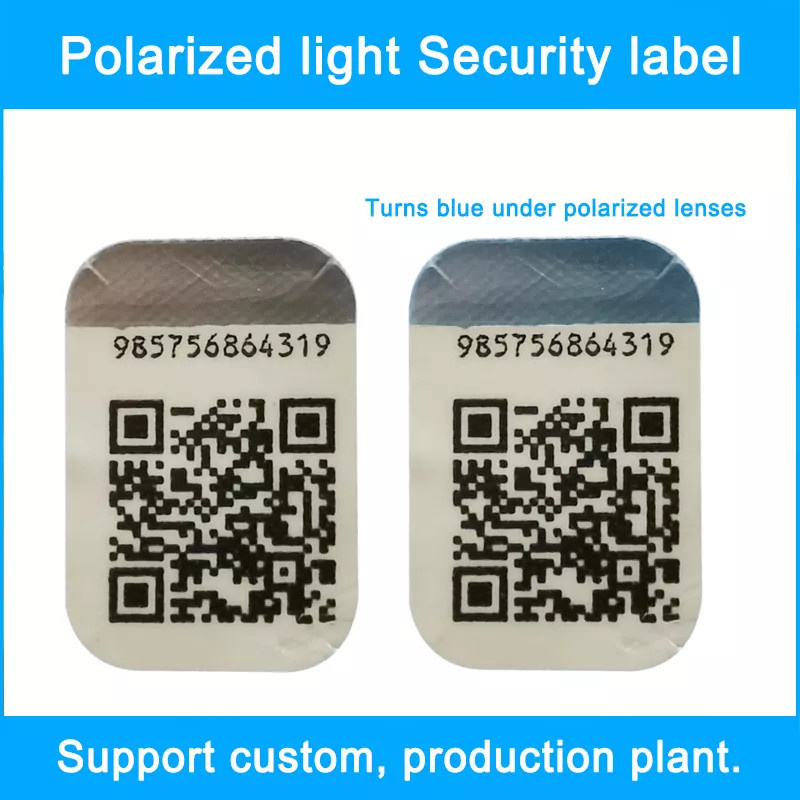
What a Polarized Security Label Does
A polarized security label adds a verification layer that a photocopier and a desktop scanner cannot reproduce. The label carries an optically active film or ink layer that responds to a polarizing filter: viewed through the filter, a hidden image, color shift or pattern appears; viewed without it, the same area looks plain or shows only a faint tint. Because the effect depends on the polarization state of reflected light rather than on a printed image, it survives ordinary photography as a copy protection measure — a photo of the label does not carry the effect.
For brand owners, this means a field inspector, customs officer or retail auditor can authenticate a carton or bottle with a small polarizing film held over the label surface and a check against a known reference. No app, no database lookup and no network connection are needed for the first-line check, which is what makes the technology practical in distribution channels where connectivity is unreliable.
Shenzhen Huaxin Anti-Counterfeiting Technology Co., Ltd. has manufactured security labels in Shenzhen since 2008 and works with more than 60 anti-counterfeiting technologies, which allows us to combine a polarizing layer with other features on a single label rather than treating it as a standalone product.
How Polarizer Verification Works, in Plain Terms
Light from ordinary indoor or daylight sources vibrates in many directions at once. A polarizing filter absorbs most of that light and passes only the component aligned with the filter's axis. When a label is built with a polarization-sensitive layer, the light reflected from the label is altered in a predictable way, so the filter either reveals the hidden element or blocks it.
The practical consequence is a simple pass/fail test with two states:
- Filter aligned one way: the covert image or color shift is visible.
- Filter rotated 90 degrees or removed: the image disappears or the color reverts.
A genuine label changes state when the filter is rotated. A printed imitation does not, because printing cannot control the polarization of reflected light. That single behavior is the core of the verification, and it is why we recommend training inspectors on rotation rather than on a static appearance — the change of state is the evidence, not the picture itself.
Formats and Optical Effects We Manufacture
Polarized anti-counterfeiting labels are made to order, and the optical design is chosen to fit the substrate and the way the product is handled. Common configurations include:
- Laser hot-stamping film polarized labels with a custom trademark. The metallized film carries the polarized effect and the brand mark in one construction, suited to premium packaging where the label is also a visual element.
- Polarized labels with a QR code and color change. The QR code supports digital verification while the polarized area provides the offline optical check, so the same label serves two verification routes.
- Packaging stickers and seal formats for cartons, cases and outer packaging, where the label must survive handling and remain readable at the seal line.
A documented example of a two-color polarized security construction is a wine label produced for the Kenya market, where the two-color polarized element served as the primary optical authentication feature on the bottle. If your application is beverage-related, the wine security labels range shows how optical features are combined with tamper evidence on glass.
Matching the Effect to the Substrate
The optical effect behaves differently on metallized film, clear film, paper and foil. On a dark glass bottle, a two-color polarization shift reads more clearly than a single-tone effect; on a white carton, a metallized film base usually gives the strongest contrast. We confirm the construction against your actual substrate before production, because the same optical design can look convincing on a sample sheet and weak on the finished pack.
Specifications, Capacity and Quotation
This product is custom, and we do not publish a fixed price or minimum order for it. Specifications, artwork requirements and pricing are confirmed per project at the quotation stage, after the construction and optical effect are agreed. The table below summarizes the company and manufacturing facts that apply to polarized label orders.
| Item | Detail |
|---|---|
| Manufacturer | Shenzhen Huaxin Anti-Counterfeiting Technology Co., Ltd. |
| Location | Shenzhen, China |
| Manufacturing since | 2008 |
| Audit | TÜV Rheinland, report MIC-ASR262171 |
| Employees | 60–100 |
| Factory area | 1,500 m² |
| Monthly capacity | 510,000–1,000,000 labels |
| Anti-counterfeiting technologies | 60+ |
| Product pricing and MOQ | Confirmed per project at quotation stage |
If your launch schedule requires a large first run, share the forecast early so the polarized construction can be scheduled alongside the print run. Our security labels overview covers the other authentication technologies that can be combined with a polarizing layer on the same construction.
Choosing Between Optical and Digital Verification
Polarized labels are strongest where verification must happen without infrastructure: warehouses, bonded stores, border checks, secondary distributors and field audits. Where you also need to record each scan, a QR code on the same label provides the digital record while the polarized area remains the offline check. The two are complementary, not alternatives — the optical feature answers "is this label genuine?" and the QR code answers "which unit is this and where has it been?"
We recommend deciding the verification workflow first and the label construction second. That order avoids paying for an optical effect that inspectors are never trained to use, and it avoids a digital-only label in channels where phones are not permitted on the floor.
Request a Quote
To move forward, send us your substrate, the packaging line where the label is applied, the intended verification method and an estimated annual volume. We will propose a construction, confirm the optical effect against a physical sample, and quote the project. You can reach the team through our contact page and review related constructions in the security labels and wine security labels ranges.
FAQ
Can a polarized security label be copied by photographing or scanning it?
No. The verification depends on how the label changes the polarization of reflected light, and a photograph or scan records color and shape but not that behavior. A copy may look similar under normal light, but it will not change state when a polarizing filter is rotated over it.
What does the inspector actually do to verify a label?
The inspector places a small polarizing filter over the marked area and rotates it. On a genuine label, a hidden image, pattern or color shift appears and then disappears as the filter turns. The check takes a few seconds and needs no device, app or network connection.
Can the polarized effect be combined with a QR code or a tamper-evident seal?
Yes. We produce polarized labels that also carry a QR code with a color-change element, and we produce packaging sticker and seal formats. The combination lets you keep an offline optical check while adding a digital record or a tamper-evident construction on the same label.
Request a Quote
Tell us the label type, size and quantity. Zhao Hua's team replies with construction options, sampling and a volume price.
Request a Quote WhatsApp +86 136 7009 2422