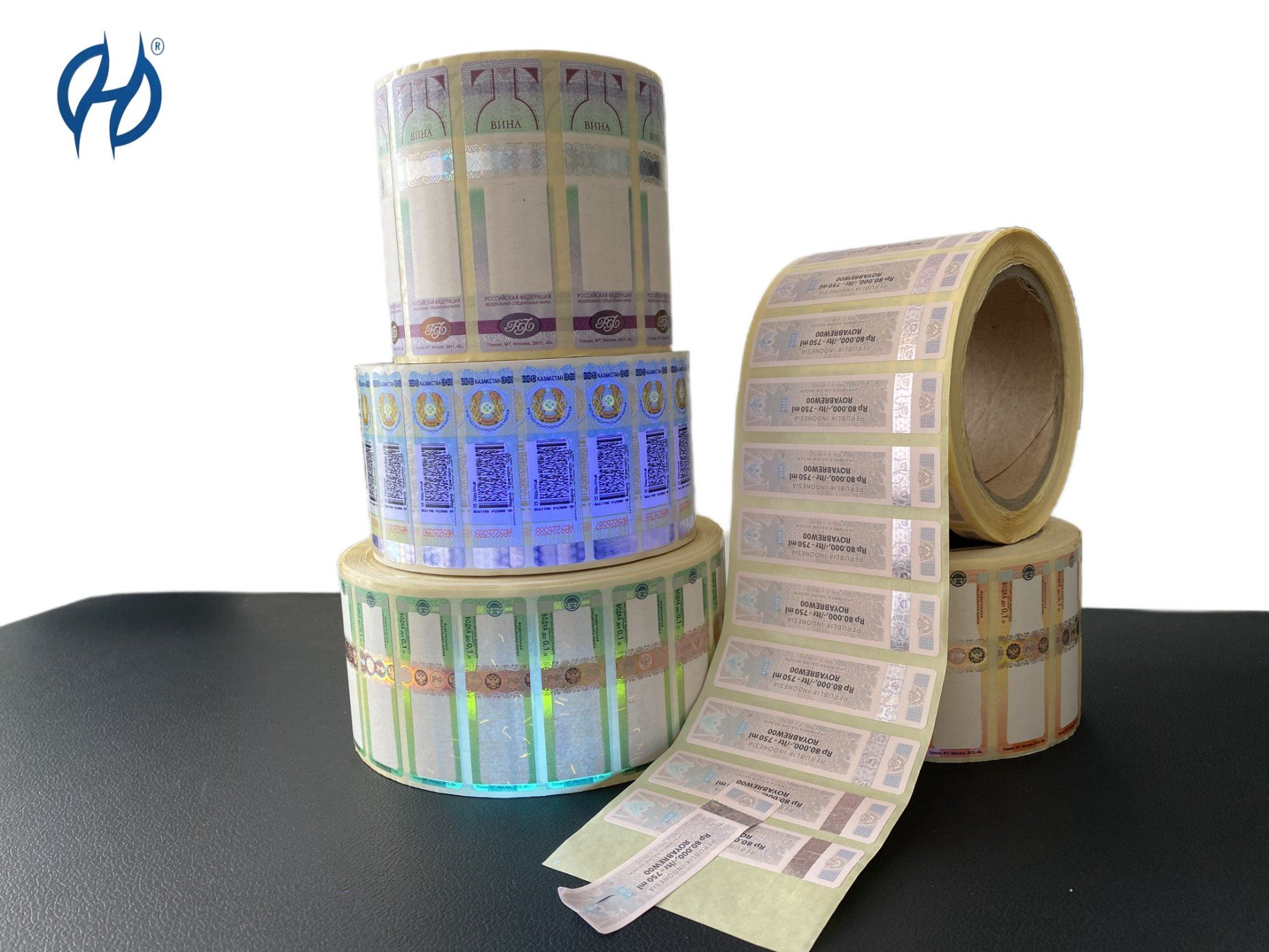
What a Tax Stamp Has to Do
A tax stamp is a small printed document with a large job: it proves that duty has been paid, it has to survive handling and storage, and it has to be difficult to copy. That combination is why tax stamps are printed with security features rather than ordinary commercial print. The features need to be visible enough for inspectors to check in the field and complex enough to stop casual and semi-professional counterfeiters.
We produce tax stamps as part of a broader security label operation: 60–100 employees, a 1,500 m² factory in Shenzhen, and monthly capacity of 510,000 to 1,000,000 labels. That range suits both recurring excise programmes and campaign-based orders.
Security Features for Tax Stamps
The feature set is chosen per project, based on the level of inspection the stamp will face and the budget per unit. Three features we use regularly:
- Rainbow micro-text. Very small text printed with a colour transition across the line. It reads as a colour shift at arm's length and resolves into legible characters under magnification.
- Fluorescent fibers. Fibers embedded in the substrate that are invisible in normal light and respond under UV. They are difficult to reproduce without the same substrate supply.
- Holography. Holographic elements, including hologram excise stamps, give a recognisable visual marker that can be checked quickly without equipment.
These can be combined. A stamp might carry a holographic patch, micro-text in the border, and fluorescent fibers in the paper — three checks at three different levels of scrutiny.
Product Formats and Pricing
We supply tax and excise stamps in several formats. The table below gives indicative figures; final pricing depends on artwork, feature mix, and order volume.
| Item | Detail |
|---|---|
| Cigarette labels with tax stamp printing | US$0.15–0.30 (tiered), MOQ 10,000 |
| Wine and cigarette sealing duty stamps | US$0.035–0.05 at 100,000+ |
| Custom tax stamps | MOQ 100,000 at US$0.01, 5–15 days after sample approval |
| Hologram excise stamp (supplied for the Mozambique market) | US$0.15–0.30, MOQ 10,000 |
The custom tax stamp tier is the entry point for buyers who need their own artwork and feature combination at volume. The lower unit price reflects the larger run. For buyers whose requirement is specifically cigarette packaging with integrated tax stamp printing, the cigarette labels range covers that format. Buyers working on wine and spirits closures should look at our wine security labels, where sealing duty stamps are often specified alongside the closure label.
Custom Tax Stamps: From Artwork to Delivery
Custom work starts with the artwork and the security brief. We need to know what the stamp must prove, who will inspect it, and what equipment inspectors will have. From there we propose a feature set and produce a sample. Production runs 5–15 days after sample approval — a window that assumes the artwork is final and the feature set is confirmed at sample stage.
Two practical points for planning. First, allow time for the sample approval step itself; it is not inside the 5–15 days. Second, confirm the variable data early if the stamp carries serial numbers, batch codes, or region marks, because that data drives both the plate work and the inspection plan.
The Mozambique hologram excise stamp in the table is a product we have supplied for that market. It illustrates the format: a holographic excise stamp at a mid-range unit price and a 10,000 MOQ.
Choosing the Right Format
The decision usually comes down to three questions. What is the substrate — paper, foil, or a film applied to a carton or closure? What inspection will the stamp face — visual only, UV, or magnification? And what is the annual volume, since that sets which price tier applies? A duty stamp programme for alcohol and tobacco typically combines a closure seal with a tax stamp, and our duty stamps for alcohol and tobacco page sets out how those two elements work together. For a format outside the standard ranges, the custom tax and excise stamps section covers bespoke specifications.
Request a Quote
Send us your artwork, the substrate, the inspection conditions, and your expected annual volume, and we will come back with a feature proposal and pricing at the right tier. You can reach the team through our contact page — include the destination market and any variable-data requirements so the first response is specific rather than generic.
FAQ
What is the difference between a tax stamp and an excise stamp?
The terms are often used interchangeably. In practice, "excise stamp" usually refers to a stamp applied to a specific dutiable product such as alcohol or tobacco, while "tax stamp" is the broader term for a stamp proving duty or tax has been paid. The security requirements are similar; the difference is mainly the product and the regulatory context.
What is the minimum order for custom tax stamps?
Custom tax stamps start at an MOQ of 100,000 units at US$0.01 per unit, with production of 5–15 days after sample approval. Smaller quantities are available on other formats — for example, cigarette labels with tax stamp printing have an MOQ of 10,000. The right tier depends on your volume and feature requirements.
How long does production take?
For custom tax stamps, 5–15 days after sample approval. That window does not include sample production and approval, so build that step into your schedule. Confirm variable data — serial numbers, batch codes, region marks — before sampling so the approval covers the final specification.
Request a Quote
Tell us the label type, size and quantity. Zhao Hua's team replies with construction options, sampling and a volume price.
Request a Quote WhatsApp +86 136 7009 2422