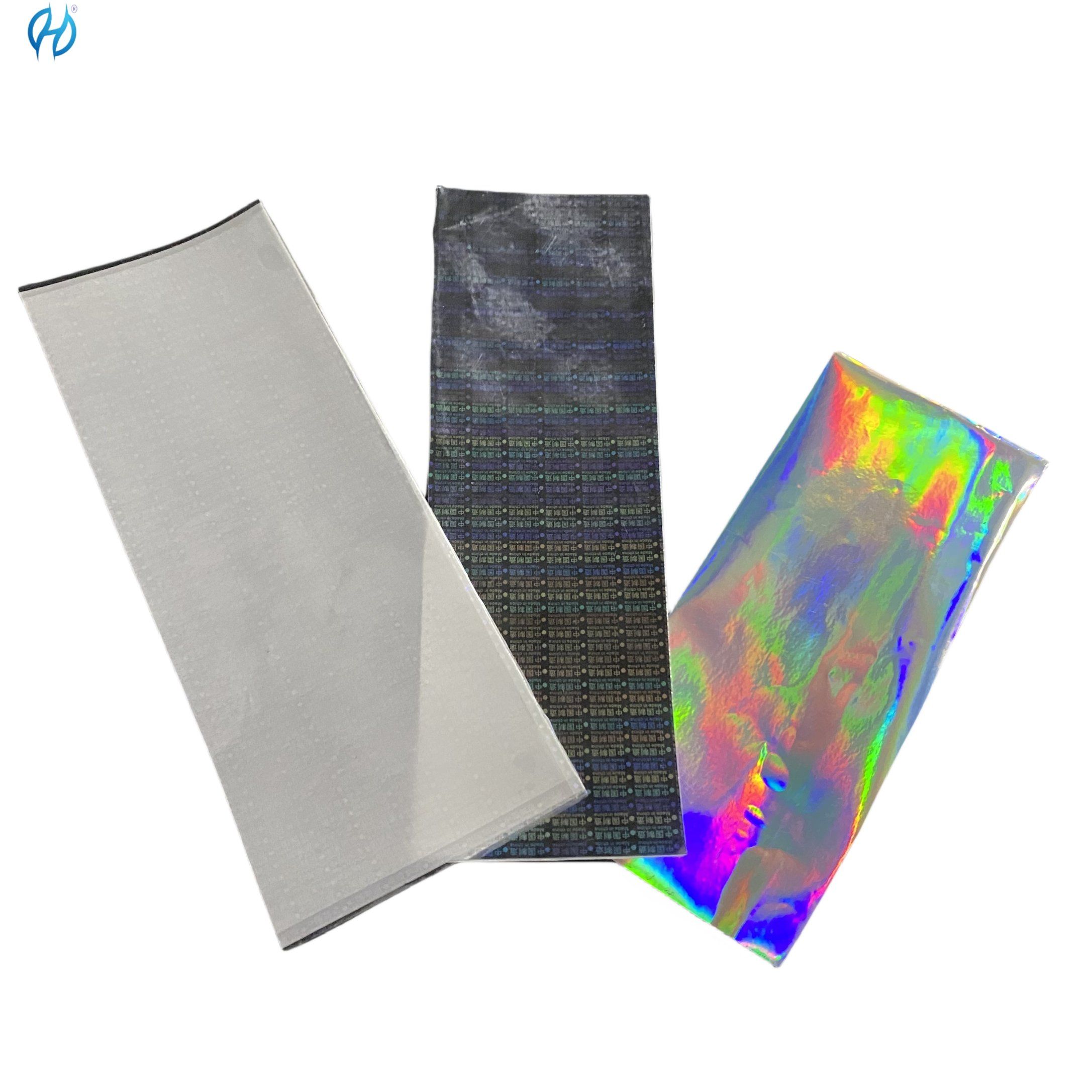
What Holographic Security Labels Do
A hologram is a recorded interference pattern that reconstructs an image when light strikes it at the correct angle. Because the master originates from a physical optical recording rather than a printable file, the visual effect is extremely difficult to reproduce without access to the original origination. That is the basis of its security value: a counterfeiter can scan and print a picture of a hologram, but the copy will not change colour, shift depth or replay the same optical behaviour as the genuine label.
Holographic security labels are used in three broad ways. The first is overt authentication — the label is meant to be seen, and a distributor, inspector or consumer can check it without tools. The second is tamper evidence: a label that destroys itself on removal shows whether a package has been opened or a product re-labelled. The third is process control, where serialised or numbered holograms allow a manufacturer to reconcile production against issued stock.
Shenzhen Huaxin Anti-Counterfeiting Technology Co., Ltd. has manufactured security labels in Shenzhen since 2008. The company operates a 1,500 m² factory with 60–100 employees and a monthly capacity of 510,000 to 1,000,000 labels, and the factory is a TÜV Rheinland Audited Supplier (report MIC-ASR262171). The portfolio draws on more than 60 anti-counterfeiting technologies, of which the holographic optical family is a core group.
The Optical Technology Family
Holographic security labels are not a single product but a set of origination and replication techniques. Four are most relevant to brand-protection buyers, and they are frequently combined on one label.
Laser holographic origination produces the familiar bright, high-contrast image with strong colour movement. It is the workhorse process for flat hologram labels and the most cost-efficient way to add an overt security feature at high volume.
Concave-lens holography records a lens array into the hologram so that the reconstructed image appears to sit behind or in front of the label surface. The depth effect is easy to verify by eye and hard to simulate with print.
Rainbow-gradient holographic micro-text combines a colour sweep across the label with microtext too small to read without magnification. The gradient gives an obvious visual check; the microtext gives a second, documented check for inspectors.
Multi-band laser colour-changing metallic thread introduces a thread element whose colour shifts across defined bands as the viewing angle changes. It suits tamper-evident seals and documents where a thread can be integrated into the substrate.
These techniques can be layered with serialisation, QR or barcode printing, and destructive adhesive systems. For buyers who want to compare specific formats, the laser hologram label range covers flat laser hologram labels and their pricing tiers, while the 3D hologram sticker range covers depth-effect stickers in detail.
Choosing the Right Format
The right format follows from the application, not the other way round. Three questions usually settle the specification.
Is the label checked by eye or by a device? If consumers or retail staff are the primary checkers, prioritise a strong overt effect — a deep 3D image, a clear colour shift, or a rainbow gradient. If the check is performed by an authorised inspector, microtext and serialisation matter more, because they support a recorded verification step.
Is the label a seal or an identifier? Tamper-evident seals need a destructive adhesive and a substrate that fractures on removal. Product identifiers on a carton or bottle can use a permanent adhesive and a smaller format.
What does the application surface look like? Curved, textured, cold, damp or oily surfaces all affect adhesion and the appearance of the hologram. Share a sample of the actual packaging with your supplier so the label can be tested on the real substrate rather than a specification sheet.
For projects that need a bespoke optical design rather than a catalogue format, custom hologram sticker development allows the image, microtext and colour behaviour to be built around your brand and your inspection process.
Specifications, Pricing and Volume
The table below summarises the two core formats in this category. Figures are indicative for planning purposes and are confirmed at quotation against your artwork, size and adhesive requirements.
| Item | Detail |
|---|---|
| Custom holographic laser 3D stickers | US$0.03–0.08 per piece; MOQ 10,000 |
| 3D hologram stickers | US$0.15–0.30 per piece; MOQ 10,000 |
| Monthly capacity | 510,000–1,000,000 labels |
| Factory | 1,500 m², Shenzhen; 60–100 employees |
| Quality audit | TÜV Rheinland, report MIC-ASR262171 |
| Technology portfolio | 60+ anti-counterfeiting technologies |
Two points are worth flagging for budget planning. First, unit price is driven mainly by origination cost, label size, substrate and any variable data; a larger order amortises the origination over more pieces. Second, the 3D format sits at a higher price point than the flat laser format, and the two are costed separately. Buyers comparing the two should cost them against the value of the product being protected, not against each other in isolation.
Ordering and Lead Time
Most projects follow a defined path: artwork and security review, origination or sample selection, a physical proof for approval, then production and dispatch. Origination is the long-lead item on a new design, so allow time for proofing before committing to a launch date. Repeat orders run against the approved master.
Provide artwork in vector format where possible, state the label dimensions and the application surface, and specify whether variable data is required. If the label must integrate with an existing inspection or track-and-trace process, say so at enquiry stage so the numbering and marking can be planned into the job rather than added afterwards.
To discuss a specification or request a quotation, contact the sales team with your artwork, target volume and application details. You can also review the laser hologram label range and the 3D hologram sticker range before you write the brief.
FAQ
How do I know which hologram type suits my product?
Start with who verifies the label and how. Overt checks by consumers or retail staff favour strong visual effects such as 3D depth or a rainbow gradient; inspector-led checks favour microtext and serialisation. The application surface and whether the label acts as a seal or an identifier then narrow the format further.
What is the minimum order quantity?
Both core formats in this category carry a minimum order of 10,000 pieces. Unit pricing is quoted against your specific artwork, size, substrate and variable-data requirements, because these determine material use and production time.
Can holographic labels be combined with other security features?
Yes. Holographic effects are commonly layered with serialisation, QR or barcode marking, microtext and tamper-evident adhesives. The combination should be chosen to match your verification process, so describe the inspection step when you enquire.
Request a Quote
Tell us the label type, size and quantity. Zhao Hua's team replies with construction options, sampling and a volume price.
Request a Quote WhatsApp +86 136 7009 2422