Why Choose an Anti-Counterfeiting Technology by Family?
No single feature stops every counterfeiter. A deliberate mix works better: something a customer can check at a glance, something an inspector can verify with a simple tool, something a laboratory can confirm beyond doubt, and something that ties the label to a serialised record. The four families below are organised that way, from the most visible to the most technical.
Overt Technologies: Verified by Eye
Overt features are visible without tools, which makes them fast to check at a retail counter or during a market sweep.
- Laser holography — a reflective image that shifts as the label is tilted; familiar to most buyers and cheap to inspect.
- Dual-cut phase 3D embossed holography — a hologram built from two cutting phases to give a deeper three-dimensional effect.
- Multi-band laser color-changing metallic thread — a thread whose colour changes across bands when viewed from different angles.
- Refractive latent images — an image that appears only at a chosen viewing angle.
- Paper-texture anti-counterfeiting — a surface finish that is difficult to reproduce on standard printing equipment.
- Security threads — threads embedded in the label substrate, visible in transmitted light.
Covert Technologies: Checked with a Simple Tool
Covert features are invisible or near-invisible in normal light and are read with a UV lamp, magnifier or polarising filter — enough for field inspectors without laboratory support.
- Dotted curved multi-spectrum fluorescent fibers — fibres that respond at selected wavelengths under excitation.
- Chemical inks — inks that react to a specific stimulus, used to mark a verification point.
- Invisible images — printed marks that stay hidden until the correct viewing condition is applied.
- Polarized features — elements readable only through a polarising filter.
- Nano wet-sensitive — a nano-scale element that responds to moisture contact.
- Ultra-micro positioned hollow engraving — very small engraved characters placed at a defined position, readable under magnification. See the micro and nano micro-text labels for how these are built into a label.
Forensic Technologies: Confirmed in the Laboratory
Forensic features are not intended for routine inspection. They exist so that a disputed sample can be tested and confirmed with equipment and records a counterfeiter cannot easily match.
- Biological — a biological marker used as a laboratory-level authentication element.
- Nuclear-track — tracks created under controlled conditions and verified under magnification.
- MR (magnetic resonance) — a magnetic response read with dedicated equipment.
- Texture — a physical signature used to confirm that a sample matches the original production run.
Digital and Data Technologies: Serialisation and Tracking
Digital features connect the physical label to a data record, so each unit can be identified individually rather than as a batch.
- QR and barcodes — carry a serial number or verification URL for scanning.
- Digital anti-counterfeiting — a coded identity linked to a verification record.
- RFID — a chip that can be read without line of sight for stock and logistics checks.
- Staged decryption — information released in steps, so a partial inspection reveals only part of the payload.
- Coding — serialisation applied as part of the label print run.
Multi-layer and Combined Constructions
Most programmes combine families rather than relying on one. A typical construction might pair an overt hologram for customer reassurance with a covert fluorescent fibre for inspector checks and a serialised code for traceability. Multi-layer labels support this by stacking two or more features in one carrier, and the same logic underpins the brand protection solutions Huaxin builds for clients.
Factory and Capacity Reference
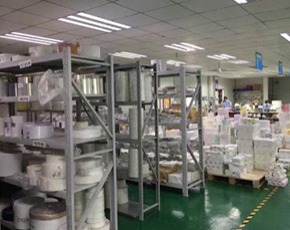
Huaxin operates a 1,500 m2 factory with 60–100 employees, produces 510,000–1,000,000 labels per month, and has been audited by TÜV Rheinland (report MIC-ASR262171). The table below summarises the reference figures buyers most often ask for.
| Item | Detail |
|---|---|
| Manufacturer | Shenzhen Huaxin Anti-Counterfeiting Technology Co., Ltd. |
| Location | Shenzhen, China |
| Operating since | 2008 |
| Employees | 60–100 |
| Factory area | 1,500 m2 |
| Monthly capacity | 510,000–1,000,000 labels |
| Anti-counterfeiting technologies available | 60+ |
| Audit | TÜV Rheinland, report MIC-ASR262171 |
How to Specify the Right Mix of Anti-Counterfeiting Technology
Start with two questions: who checks the product, and what happens when a check fails? If retail staff do the checking, weight the mix toward overt and tool-assisted covert features. If customs or brand-protection teams carry out seizures, add forensic features and keep a reference sample on file. If the goal is to trace a specific unit back through the supply chain, digital features and serialisation are the backbone.
Then match the feature to the substrate and the print process. Holographic and thread-based features impose constraints on label material and finishing, while fluorescent fibres and chemical inks affect ink selection. For labels applied to small parts or high-value components, micro-text and engraving features may be more practical than large holograms; the micro and nano micro-text labels page covers that case. Discuss the inspection workflow with us early — it is easier to design a label around the check than to train staff around the label.
FAQ
How many anti-counterfeiting technologies can be combined on one label?
There is no fixed ceiling, and the practical limit is set by the substrate, the printing process and how the label will be inspected. Most programmes use two to four features drawn from different families so that a failure in one check does not leave the product unprotected. Huaxin's reference list covers more than 60 technologies, which allows the mix to be tailored rather than chosen from a fixed catalogue.
Which technologies work best for field inspection without laboratory equipment?
Overt features such as laser holography and refractive latent images need no equipment at all, and covert features such as fluorescent fibres, invisible images and polarised elements read with a UV lamp, magnifier or filter. Forensic and magnetic features are reserved for laboratory confirmation when a dispute arises. A common arrangement is one overt, one covert and one digital feature, with forensic elements held back for escalation.
Do I have to choose between a physical feature and a digital code?
No — they serve different purposes and work well together. A physical feature authenticates the label itself, while a code or RFID chip links the unit to a serialised record for tracking and verification. Combining them means a copied label can be detected both by its physical construction and by a duplicate serial number appearing in the system.
How do I get a quotation for a specific technology mix?
Send your label size, substrate, application method, expected volume and the inspection workflow you plan to use. We will propose a feature mix, confirm which technologies fit the construction, and quote against your volume. You can request a quote or review the brand protection solutions first if you are still comparing approaches.
Request a Quote
Tell us the label type, size and quantity. Zhao Hua's team replies with construction options, sampling and a volume price.
Request a Quote WhatsApp +86 136 7009 2422