A Security Label Range Built Around Six Product Families
Counterfeiting rarely looks the same twice, so a single label type is seldom enough. Our range is grouped into six categories, each aimed at a different failure mode:
- Double-layer anti-peel labels — a top layer that separates from a base layer on removal, leaving a permanent residue and a visible trace.
- VOID security labels — leave a "VOID" message on the surface when peeled, making transfer to another product obvious.
- Fluorescent labels — invisible under normal light and readable only with a UV source.
- Polarized labels — use polarization effects that are difficult to reproduce on standard printing equipment.
- QR code labels — combine a scannable code with a security construction for verification workflows.
- Custom anti-counterfeiting labels — engineered combinations of the above when a single technology is not sufficient.
If you are still mapping requirements, start with the custom anti-counterfeiting labels overview, which covers how these technologies are combined.
Matching Security Labels to Your Threat Model
The right question is not "which label is best" but "what attack are you trying to stop". Three common scenarios:
Product refilling and reuse. A genuine bottle or carton is opened, refilled with counterfeit goods, and resealed. Here the label must be single-use. VOID constructions and double-layer anti-peel constructions both destroy themselves on removal, so a resealed package cannot look untouched.
Visual imitation. A counterfeit carton is printed to look identical to the original. Overt and covert features raise the copying cost: fluorescent inks that only respond under UV, and polarized effects that ordinary presses cannot replicate.
Verification at scale. Staff or consumers need to check authenticity quickly. A QR code label links the physical item to a verification record while the security substrate discourages removal and reapplication onto other goods.
Most programs combine two or three of these. Review the VOID security labels and double-layer anti-peel labels pages for constructions, or ask us to recommend a combination based on your product and distribution channel.
Materials, Sizes, and Formats
Custom sizes and shapes are standard. Labels can be supplied on rolls for automatic application lines or on sheets for manual use. Substrate, adhesive, and security feature are selected per application — the surface being labeled (glass, plastic, coated board, film) usually determines the adhesive choice more than anything else.
Manufacturing and Quality Control
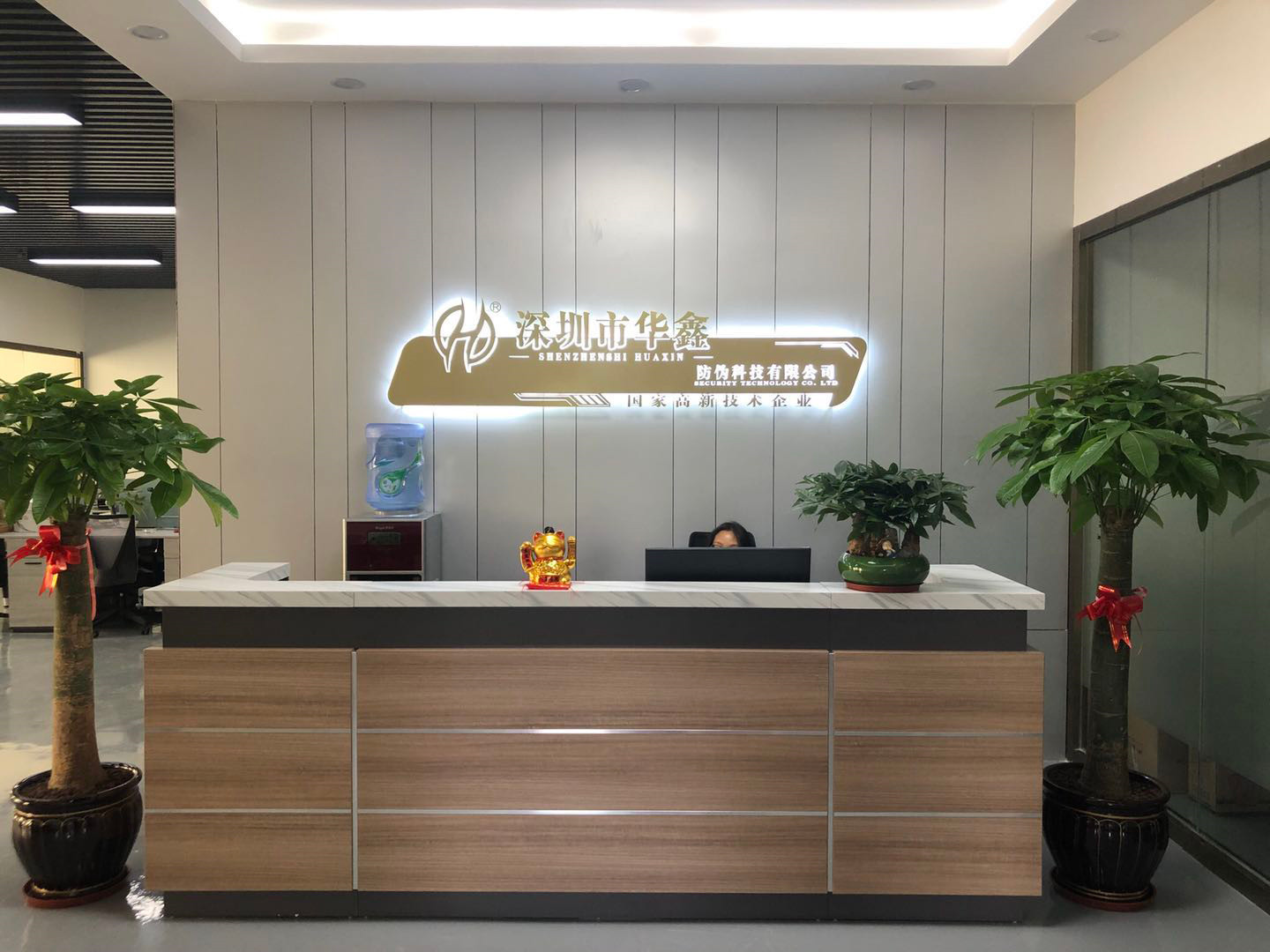
We operate a 1,500 m² factory in Shenzhen with 60–100 employees. Production has run since 2008, and the factory is a TÜV Rheinland Audited Supplier (report MIC-ASR262171). Certificates for CE, RoHS, and ISO 9001 are available upon request.
Because security labels fail silently — a label that peels cleanly or a UV feature that does not register is only discovered in the field — we treat sample approval as the critical control point. Production runs are matched against the approved sample.
| Item | Detail |
|---|---|
| Minimum order quantity | 10,000 pcs |
| Trial orders | Accepted |
| Monthly capacity | 510,000 – 1,000,000 labels |
| Sizes and shapes | Custom |
| Formats | Rolls or sheets |
| Certification | TÜV Rheinland Audited Supplier (MIC-ASR262171) |
Ordering Custom Security Labels: What to Send Us
To quote accurately, we need four things: the substrate the label will be applied to, the approximate label size and shape, the security features you require, and the application method (automatic line or manual). If you already have artwork or a QR code payload, include it. If you do not know which construction fits, describe the counterfeiting risk instead and we will propose options.
Fluorescent and polarized features are worth sampling before a full run — their appearance under your own inspection equipment matters more than any specification sheet. See fluorescent security labels and polarized security labels for background before requesting samples.
Request a Quote for Your Security Labels
Send your specifications and we will respond with a construction recommendation, sample lead time, and pricing at your volume. Use the contact page to reach our team, or browse the full custom anti-counterfeiting labels range to shortlist technologies first. Trial orders are accepted; the standard minimum order is 10,000 pcs, so you can validate a construction on your own packaging before committing to production volumes.
FAQ
What is the minimum order for custom security labels?
Our MOQ is 10,000 pcs. Trial orders are accepted, which lets you test a construction on your actual packaging and application equipment before scaling up.
Can you combine several anti-counterfeiting technologies in one label?
Yes. Combined constructions are common — for example, a VOID release pattern with fluorescent printing, or a QR code on a polarized substrate. With 60+ technologies available, we select the combination based on the counterfeiting risk you describe rather than defaulting to a single feature.
Do you supply labels on rolls for automatic application?
Yes. Labels are available on rolls or sheets. Tell us your applicator type and line speed when requesting a quote so the roll direction, core size, and spacing suit your equipment.
Request a Quote
Tell us the label type, size and quantity. Zhao Hua's team replies with construction options, sampling and a volume price.
Request a Quote WhatsApp +86 136 7009 2422