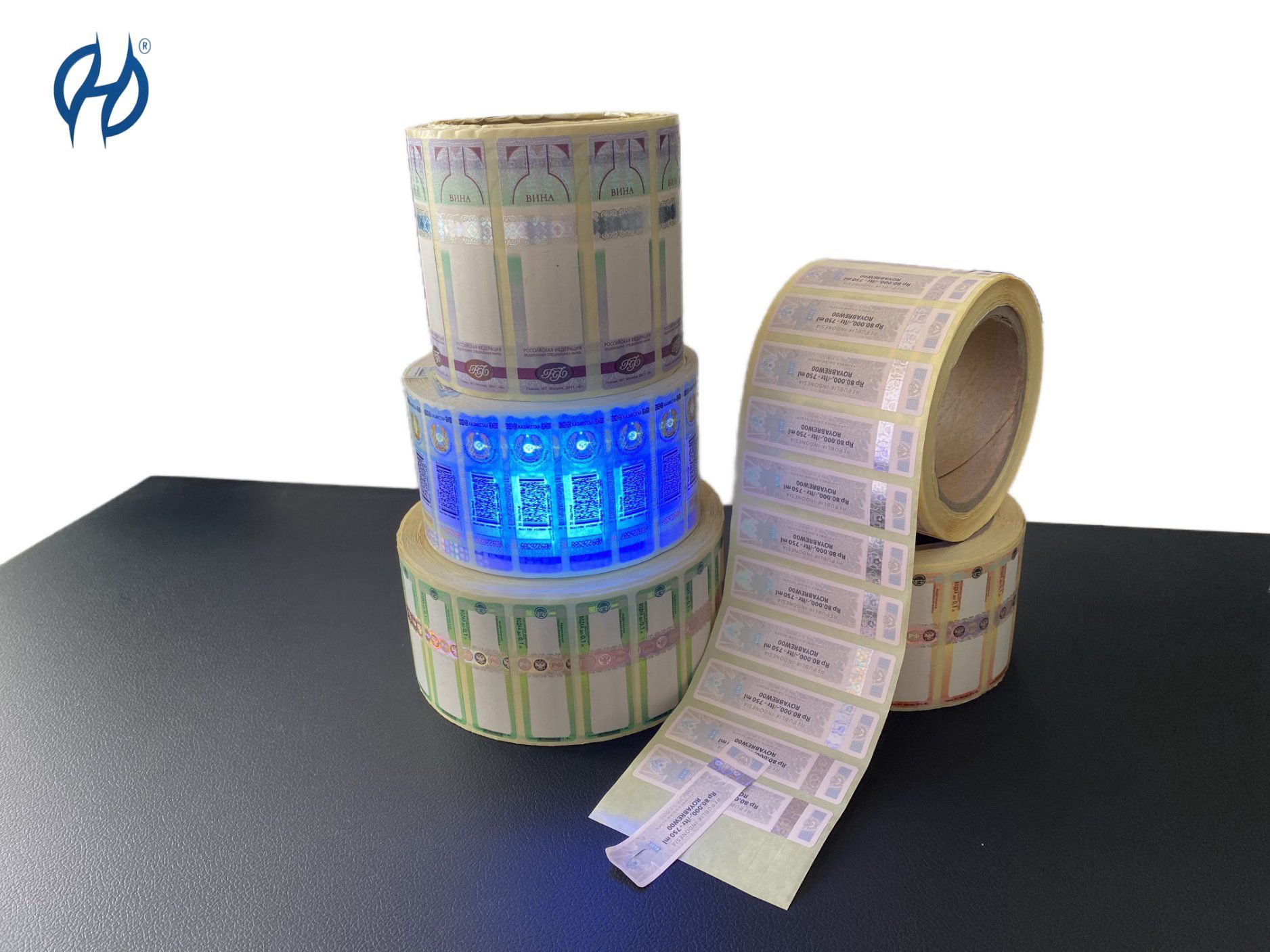
What a tamper evident seal does on a package
A tamper evident seal is a single-use adhesive label designed so that any attempt to lift, peel, or reapply it leaves visible damage - either to the label itself or to the surface beneath it. The purpose is not to make opening impossible; it is to make opening obvious. That distinction matters when you write the specification, because the seal has to fail visibly at the right moment and under the right conditions, not simply hold tightly.
For adhesive seals, tamper evidence comes from three mechanisms working together: a security adhesive that grabs the substrate and transfers onto it when peeled, a face material that tears or delaminates rather than stretching cleanly, and a printed or covert feature that cannot be reproduced by photocopying or reprinting. A seal that only satisfies one of these is easy to defeat in practice - for example, a strong adhesive on a film face can often be lifted with heat and laid back down.
We have manufactured security labels in Shenzhen since 2008, hold a TÜV Rheinland audit report (MIC-ASR262171), and work from a 1,500 m² factory with 60–100 staff and a monthly capacity of 510,000 to 1,000,000 labels. More than 60 anti-counterfeiting technologies are available across our product range, and the sealing formats below draw on that set where a project calls for overt or covert authentication on top of tamper evidence.
Adhesive seal formats for tamper evident seals
The format decision usually follows from the substrate and the opening action, not from the security feature. These are the adhesive formats in our range, with a scope note at the end on two formats that sit outside it.
VOID and residue-transfer labels
A VOID label uses a message-transfer adhesive: when peeled, the word VOID (or a custom message or pattern) remains on the carton or container surface while the label face carries the matching negative. Residue-transfer variants leave a partial adhesive pattern instead of a clear word. These suit corrugated cartons, rigid boxes, and cases where a clean visual record of attempted entry is more useful than an intact label. See our VOID security labels for the standard construction options.
Scope note: formats outside this range
Two formats buyers often group with sealing labels sit outside the adhesive label range covered here: destructible frangible papers, whose face fractures into small pieces when lifted, and continuous security tapes, which run a printed VOID message along a strip rather than a die-cut label. Neither is listed in our range; the sealing work we produce is die-cut adhesive labels, including the VOID and wine and cigarette sealing formats above.
Wine and cigarette sealing labels
For glass finishes and cigarette cartons, the seal has to work on a narrow lip or a tight fold. These formats pair a tamper evident construction with brand printing and can carry authentication features where required. Our wine security labels page shows typical constructions for bottle-neck and closure sealing.
Security labels with authentication features
Where the seal also needs to prove authenticity, we can add overt or covert elements - serialization, hidden marks, or other features from the 60+ technologies we run - so the same label acts as both a tamper evident seal and an authentication carrier. Ask for the specific feature list relevant to your risk model rather than assuming a standard build includes it.
Matching the seal to the application surface
Adhesive performance depends more on the substrate than on the label alone, and this is the most common source of field complaints. Glass and coated metals are non-porous and typically need a higher-tack adhesive and careful surface cleaning to reach full bond strength. Corrugated cartons are porous and fiber-tearing, which often means the seal fails by pulling fiber - useful for tamper evidence, less useful if you need the label to stay flat for scanning. Pouches and film laminates are the hardest case: low surface energy films require specific adhesive selection and usually a trial run before production.
Practical rules we apply at quoting: always test on the actual production substrate, not a sample with a similar description; account for cold or damp conditions if the package is sealed in a cold chain; and check the seal against the opening tool a consumer will use. A seal that shreds the carton top when opened is evidence, but it is also a customer complaint if it damages the product.
How to specify a tamper evident sealing label
Write the specification around the failure you want to detect. In practice, a workable brief answers five questions: What surface is being sealed, and is it clean and dry at application? What opening action should the seal reveal - peeling, cutting, or breaking? Should the tamper message be a standard VOID, a custom word, or a residue pattern? Does the seal also need an authentication feature or serialization? And what volume and finish do you need per run?
Size matters too: measure the actual seam or lip you are sealing and allow enough overlap that the label cannot be lifted at a corner. If the package is printed with a brand design, confirm whether the seal is applied over ink or over an unprinted area, since some inks weaken adhesive performance.
Indicative pricing from our current guide, for planning only:
| Item | Detail |
|---|---|
| Wine & cigarette sealing labels | US$0.035–0.05 each at 100,000+ quantity |
| VOID carton seals | US$0.003–0.007 each, tiered by volume |
These figures are figures for early budgeting; final cost depends on size, material, printing, and the authentication features selected.
Request a sealing label quote
Send us the substrate, the opening action you want to detect, the message or feature you need, and your annual volume, and we will come back with a construction and a quotation. Start at our contact page, or review the specific product pages for wine security labels and VOID security labels before you write the brief. If your project involves bolt, cable, or container seals, note that we do not manufacture those formats and cannot quote them.
FAQ
What is the difference between a tamper evident seal and a security label?
A tamper evident seal is a single-use adhesive label that shows visible damage when someone tries to open or remove it. A security label can include tamper evidence but may focus on authentication instead, such as a serialized or covert-marked label. Many of our products combine both functions in one construction.
Do adhesive tamper evident seals work on plastic pouches and film?
They can, but film substrates need the right adhesive and a trial on the actual material. Low surface energy films often cause standard adhesives to lift at the edges, so we test the production substrate before confirming a construction. Cold or damp conditions should be factored in at the same stage.
Can I specify a custom tamper message instead of VOID?
Yes. The transfer adhesive can carry a custom word, pattern, or residue layout rather than the standard VOID message. We need artwork and the surface it will be applied to, because the transferred message has to remain legible against your carton or container finish.
Request a Quote
Tell us the label type, size and quantity. Zhao Hua's team replies with construction options, sampling and a volume price.
Request a Quote WhatsApp +86 136 7009 2422