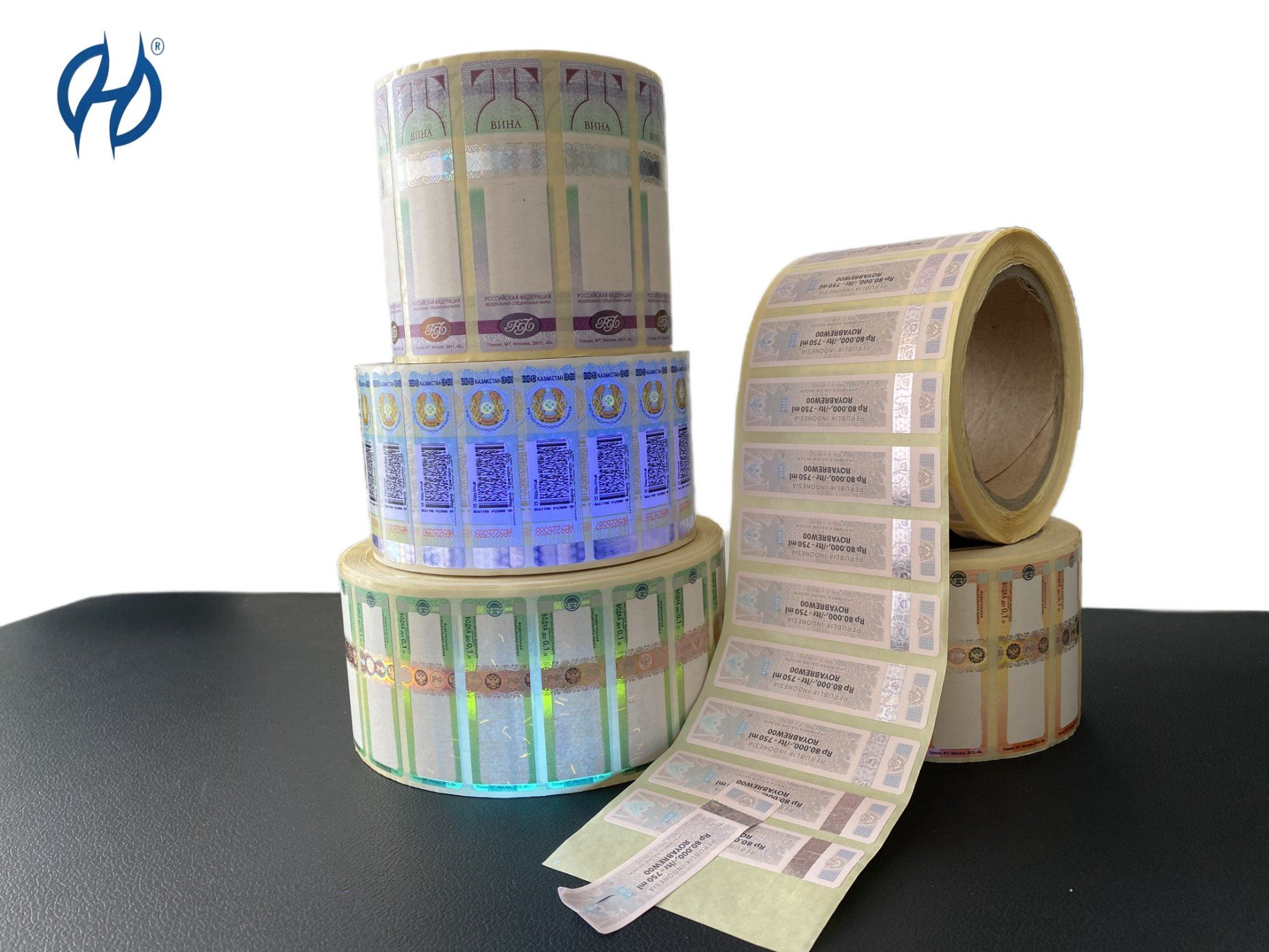
What a Tax Stamp Is and Why Governments Require One
A tax stamp — also called an excise stamp or duty stamp — is a small, security-printed label affixed to a product or its packaging to show that excise duty or another required tax has been paid. The concept is straightforward: the stamp is issued or controlled by the tax authority, sold or allocated to licensed producers and importers, and applied to the goods before they enter the market. An unstamped or improperly stamped product is, by definition, suspect.
For regulated goods such as alcohol, tobacco, and other excise-liable products, this creates a visible, checkable proof point at every stage: production, warehousing, distribution, retail, and inspection. Enforcement officers do not need laboratory equipment to start an investigation — they can look at the closure and see whether the stamp is present, intact, and genuine.
The stamp also serves a fiscal function. Because stamps are accounted for by serial number, the tax authority can reconcile the number of stamps issued against the volume of product declared. That reconciliation is where illicit trade becomes visible: product in the market that does not correspond to stamps issued, or stamps that were never legitimately acquired.
How Tax Stamps Interrupt Illicit Trade
Illicit trade in excise goods — smuggling, diversion, counterfeiting, and tax evasion — depends on ambiguity. Tax stamps reduce that ambiguity in several ways.
Proof of duty paid at the point of inspection
The most immediate effect is evidentiary. A stamp on a closure signals that duty was paid on that unit. For a retailer or distributor, accepting unstamped goods becomes a visible compliance risk. For an inspector, an absent, damaged, or reused stamp is grounds for seizure and further investigation. This raises the cost and risk of handling illicit product at every link in the chain.
Tamper evidence at the closure
Stamps are typically applied over the closure — the cap, lid, seal, or carton flap — so that opening the product destroys the stamp. This is deliberate. A stamp that is intact across the closure is difficult to remove and reapply without visible damage. That makes it harder to refill genuine packaging with illicit product or to reuse authentic packaging for counterfeit goods, both common methods in excise fraud.
Serialization and reconciliation
Variable numbering turns each stamp into a unique, accounted-for item. When numbers are recorded at issuance and checked downstream, gaps and duplicates surface quickly. A duplicated serial number is a strong indicator of counterfeit stamps; a serial number outside the issued range indicates diversion. This is where tax stamps connect directly to broader track-and-trace systems.
Raising the cost of counterfeiting
A plain paper label is easy to copy. A security-printed excise stamp with layered features — micro-text, fluorescent fibers, holography, variable data — is not. The purpose is not to make counterfeiting theoretically impossible but to make it expensive, slow, and detectable. Counterfeiters must invest in specialized equipment and materials, and the resulting fakes still tend to fail under routine inspection.
Security Features That Matter in an Excise Stamp
Security printing combines overt, semi-covert, and covert features. The right mix depends on the value of the product, the inspection environment, and the tax authority's requirements.
Overt features are visible to anyone without tools. Holograms are the best-known example: a holographic element with a recognizable image or logo is difficult to reproduce and easy to check at a glance. Color-shifting inks and fine guilloche patterns serve a similar purpose.
Semi-covert features require simple tools or specific knowledge. Micro-text — text so small it appears as a line to the naked eye — is a common example, along with latent images and features that respond to a specific light source. Fluorescent fibers embedded in the paper are visible under UV light and are difficult to replicate convincingly.
Covert and forensic features are for laboratory or specialist verification. These are used for prosecution and for confirming suspicions raised by overt checks.
Variable data — serial numbers, barcodes, QR codes, or other machine-readable elements — ties the physical stamp to a digital record. This is the bridge between the stamp as a physical proof and the stamp as a track-and-trace data point.
In practice, a well-specified excise stamp layers several of these features so that a quick visual check catches most problems while deeper verification remains available. For buyers comparing constructions, our tax stamp product overview sets out the common formats and feature combinations.
Placement, Application, and Operational Realities
A tax stamp only works if it is applied correctly, at the right point in the production or import process, and in a way that survives the journey to the consumer.
Placement over closures is the standard approach for bottles, jars, and cartons. The stamp bridges the cap and the container body so that opening breaks the stamp. For cartons, the stamp is often applied across the flap seal. Placement must be specified precisely, because a stamp that does not bridge the opening provides no tamper evidence regardless of its security features.
Application method matters as much as the stamp itself. High-volume lines typically use automated applicators that dispense, position, and press the stamp within a defined tolerance. Hand application is used for lower volumes or irregular shapes but introduces variability. Adhesive choice — permanent, removable, or frangible — affects both tamper evidence and the condition of the packaging when the stamp is removed. Frangible constructions that tear on removal are often preferred where reuse is a concern.
Durability is a practical constraint that is easy to underestimate. Stamps must survive condensation on chilled bottles, abrasion in transit, and the humidity of a warehouse. Substrate, adhesive, and laminate must be matched to the product and the supply chain, not chosen in isolation.
Reconciliation closes the loop. Stamps issued, stamps applied, stamps destroyed, and product declared must be reconcilable. Buyers should plan for how unused and damaged stamps are accounted for and destroyed, since an unaccounted stamp is a compliance exposure in its own right.
For buyers specifying a program for the first time, the detailed specification guidance on our custom tax and excise stamp page covers artwork, variable data, and application considerations in more depth.
Track-and-Trace: From Physical Stamp to Digital Record
Track-and-trace systems extend the tax stamp from a static proof of payment into a data carrier. Each stamp's variable code is recorded at issuance, associated with a production batch, and scanned at defined points in the supply chain. The result is a record that can be queried: where was this unit produced, when did it move, and does the code presented at retail match the code issued?
This has several practical consequences for brand owners.
First, it makes diversion detectable in near real time. Product intended for one market appearing in another can be flagged when its codes are scanned outside the expected territory.
Second, it supports authentication at the point of sale. A retailer or consumer can verify a code against a database, which makes counterfeit stamps easier to identify — a duplicated code or a code that was never issued stands out immediately.
Third, it produces data that is useful for enforcement and for supply-chain management. Patterns of scanning anomalies can point to specific distributors, routes, or production batches.
The physical stamp and the digital record reinforce each other. A hologram that is difficult to counterfeit is more valuable when its serial number is also checked against a database; a database is more trustworthy when the physical carrier is difficult to clone. Neither element is sufficient alone.
Specifying a Custom Tax Stamp Program
For brand owners and licensed producers ordering stamps, the specification process typically addresses artwork and branding, security feature selection, variable data format and encoding, substrate and adhesive, stamp dimensions, application method, and packaging and delivery format. Each decision interacts with the others — a frangible adhesive may limit substrate options, and a dense variable code may constrain print resolution.
Volume planning is equally important. Stamp programs are usually high-volume by nature, and pricing reflects that. The reference figures below illustrate the order of magnitude for a custom program; final pricing depends on specification and feature set.
| Item | Detail |
|---|---|
| Product | Custom tax stamps |
| Minimum order quantity | 100,000 pieces |
| Reference price | US$0.01 per piece |
| Product | Hologram excise stamps |
| Minimum order quantity | 10,000 pieces |
| Reference price | US$0.15–0.30 per piece |
| Customization | Artwork, security features, and variable numbering to specification |
These figures are a starting reference, not a quotation. Feature selection, substrate, and variable data requirements all affect cost, and buyers should confirm the specification before committing to a volume.
When preparing a request, it helps to have the following ready: the product and closure type, the required stamp dimensions, the security features under consideration, whether variable numbering or machine-readable codes are required, the expected annual volume, and the application method. With those details, a supplier can respond with a specific proposal rather than a generic range.
FAQ
What is the difference between a tax stamp and an excise stamp?
The terms are largely interchangeable in practice. "Tax stamp" is the broader term for a stamp proving that a required tax has been paid; "excise stamp" specifically refers to stamps for excise-liable goods such as alcohol and tobacco. Different jurisdictions use different terminology, but the function — proof of duty paid, applied over a closure, with security features and often a serial number — is the same.
Are tax stamps the same as track-and-trace labels?
They overlap but are not identical. A tax stamp's primary purpose is proof of duty payment; a track-and-trace label's primary purpose is to carry a unique identity through the supply chain. In many modern programs the two are combined: the tax stamp carries a variable code that is recorded at issuance and scanned downstream, so the physical stamp also serves as the track-and-trace carrier.
How do I choose security features for my excise stamp?
Start from the inspection environment and the value of the product. If inspectors check visually at retail, overt features such as holography should be prominent. If verification happens under UV light, fluorescent fibers and similar features matter. If prosecution or forensic confirmation is required, covert features are relevant. Most programs layer several features rather than relying on one, and the combination should be specified together with the variable data format so that physical and digital verification reinforce each other.
To discuss a specific requirement, request a quote through our contact page or review the custom tax stamp range and the excise stamp specification details before sending your artwork and volume forecast.
Request a Quote
Tell us the label type, size and quantity. Zhao Hua's team replies with construction options, sampling and a volume price.
Request a Quote WhatsApp +86 136 7009 2422