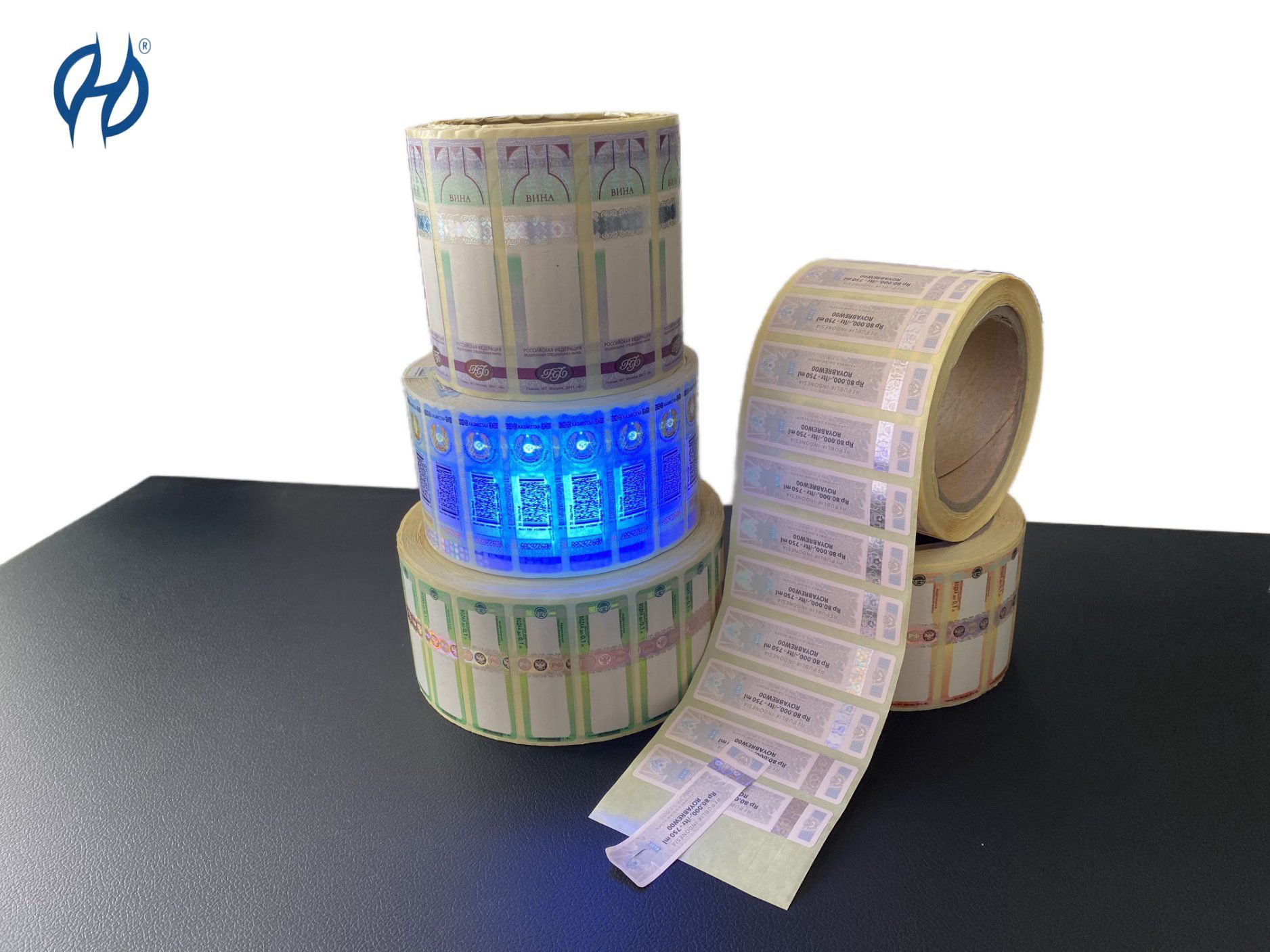
What Revenue Stamps Are and Where They Are Used
A revenue stamp is a small, security-printed label or certificate affixed to a product, package, or document to evidence that a tax, duty, fee, or other government charge has been paid. The term covers a wide family of items, from excise stamps on cigarette packs and liquor bottles to stamped paper used for contracts, receipts, and official documents. In every case, the stamp serves two purposes at once: it is a fiscal receipt, and it is a physical control measure that makes evasion, counterfeiting, and diversion more difficult.
For brand owners, revenue stamps are part of the packaging line, not a separate procurement item. They are applied at high speed, must survive the supply chain intact, and must be readable by inspection equipment at the point of retail or during enforcement checks. For authorities, the stamp is a data carrier as much as a label — the serial number, the production batch, and the distribution route all need to be recoverable and verifiable.
The design of a revenue stamp therefore balances three concerns: fiscal control, authentication, and manufacturability. The sections below address each in turn.
Main Types of Revenue Stamps
Revenue stamps are usually categorized by the product or transaction they apply to. The categories below are the most common, though specific jurisdictions define their own schemes and naming conventions.
Tobacco stamps
Tobacco excise stamps are among the most tightly controlled revenue stamps in production. They are applied to cigarette packs, cartons, and other tobacco units, often at speeds that demand precise registration and reliable adhesive performance. Because tobacco is a high-value, high-evasion category, these stamps typically carry the heaviest combination of covert and overt security features: serialized variable data, security threads, fluorescent fibers, micro-text, and frequently a holographic element. Tobacco stamps also tend to require durable construction, since packs are handled, stacked, and transported under compression.
Alcohol stamps
Alcohol revenue stamps follow a similar logic. They are applied to bottles, caps, or closures, and must withstand moisture, abrasion, and in some cases immersion in ice or condensation. Substrate and adhesive selection matter more here than in most other categories, because a stamp that lifts or smears on a chilled bottle defeats its own purpose. Alcohol stamps commonly combine a tamper-evident construction with serialized numbering and at least one overt feature that enforcement officers can check without equipment.
Document and revenue (fiscal) stamps
Document stamps — sometimes called fiscal stamps, stamped paper, or revenue paper — are applied to contracts, certificates, receipts, invoices, and official forms to evidence payment of stamp duty or similar charges. These differ from product stamps in that they are often completed with handwritten or printed entries, so the stamp must accept writing and remain legible. Document stamps frequently incorporate a reference number, an issuing office code, and a denomination, and may be produced in booklet or sheet form rather than on rolls.
Other excise and fee categories
Many jurisdictions also issue revenue stamps for other excise goods and fee categories — for example, on packaged beverages, on gaming and lottery materials, or on specific regulated services. The security logic remains consistent across these categories even when the form factor changes.
Substrates and Construction
The substrate is chosen to match the application method, the surface the stamp is applied to, and the required service life. Common constructions include:
- Paper-based stamps on security paper, often with watermarks or embedded fibers, used where wet glue or pressure-sensitive adhesive is applied and where the stamp is expected to remain permanently affixed.
- Film-based stamps on tamper-evident film, used where the stamp must fragment or leave residue if removal is attempted. These are common on bottles and closures.
- Self-adhesive roll formats for high-speed automatic application, which dominate tobacco and beverage lines.
- Sheet and booklet formats for document stamps, where manual or office application is the norm.
Adhesive choice is not a minor detail. A stamp that adheres too weakly falls off in transit; one that adheres too strongly cannot be removed cleanly for inspection without destroying the evidence. Tamper-evident constructions are specified when the act of removal itself must be detectable.
Security Features Used in Revenue Stamp Printing
Revenue stamps are built from a layered feature set. The strongest programs combine several features at different inspection levels: overt features that anyone can see, semi-covert features that require a simple tool, and covert features that require laboratory or proprietary equipment. The features below are drawn from the standard security printing repertoire.
Fluorescent fibers
Fluorescent fibers are embedded in the paper or applied to the surface during production. Under ultraviolet light they become visible, and the color, length, and distribution of the fibers can be specified to a particular issue. This is a low-cost, high-deterrence feature because the materials are not generally available and the response is easy to check at a border or retail inspection.
Micro-text
Micro-text is printing set at a size that is legible only under magnification. It can carry a repeating phrase, a serial fragment, or an issuing authority name. Because reproduction through commercial scanning and copying tends to fill in or distort micro-text, it functions as both an authentication feature and a detection aid against casual counterfeiting.
Holography
Holographic elements — applied as patches, stripes, or hot-stamped foil — provide a distinctive visual effect that is difficult to reproduce without specialized equipment. Holograms can carry serialized data and are frequently combined with a tamper-evident release layer so that attempts to lift the element leave visible damage.
Security threads
Security threads are embedded within the paper during manufacture, either fully embedded or windowed so that they appear intermittently on the surface. Threads can be metallized, fluorescent, magnetic, or carry micro-text. They are a substrate-level feature and therefore difficult to add after the fact, which makes them a strong indicator of genuine production.
Variable data
Variable data — serial numbers, batch codes, and increasingly QR codes or other machine-readable marks — is what turns a revenue stamp from a generic label into an individually traceable item. Variable-data printing requires a controlled data environment so that serial ranges are not duplicated or leaked, and it requires inspection systems that can verify print quality and number integrity at production speed. In most modern revenue stamp programs, variable data is the backbone of the control system, with the physical security features protecting the authenticity of the carrier.
How the features combine
A typical high-security revenue stamp will use a security substrate (fibers or thread), a printed security layer (micro-text, guilloche patterns, latent images), a holographic element where required, and variable data applied in a controlled sequence. The combination matters more than any single feature: a counterfeiter who can source a plausible substrate still has to reproduce the printing, the holographic element, and the serial range, and each of those is independently checked.
Revenue Stamps, Security Vouchers, and Certificates
Revenue stamps sit within a broader family of controlled print products. Security vouchers and certificates share the same production environment as revenue stamps: they are serialized, they carry layered security features, and they must be accounted for individually from production through distribution. A voucher might be redeemed for goods or services; a certificate might attest to an inspection, a qualification, or a completion. In both cases, the same disciplines apply — controlled substrate, controlled variable data, controlled spoilage and reconciliation.
For buyers, this means a revenue stamp program can often be planned alongside voucher and certificate work, sharing feature specifications, data handling procedures, and inspection standards. It also means that experience with fiscal stamps transfers directly: the same specification disciplines carry across to security vouchers and certificates planned in the same programme.
Shenzhen Huaxin has participated in drafting work on a confidential anti-counterfeiting document printing standard. That participation is recorded here as background on the factory’s document-printing work; no standard number is published with it.
Production Controls and Quality Assurance
The production of revenue stamps involves controls that go beyond ordinary label printing. Data control is the first: serial ranges must be allocated, recorded, and reconciled so that every stamp produced can be accounted for. Print control is the second: registration, color consistency, and feature placement must be verified throughout the run, not just at the start. Spoilage control is the third: defective stamps must be destroyed and recorded rather than released, and waste handling is part of the security procedure.
Inspection at the end of the line typically covers variable-data readability, serial sequence integrity, feature presence (for example, UV response and hologram placement), and adhesion performance on the intended substrate. For export programs, packaging and shipping records are part of the same chain, because a stamp that is correct at the factory but diverted in transit is still a control failure.
Specification Table
The table below summarizes the main specification dimensions buyers typically need to define. Exact values are set per project.
| Item | Detail |
|---|---|
| Stamp type | Tobacco, alcohol, document/fiscal, other excise |
| Substrate | Specified per programme |
| Security features | Fluorescent fibers, micro-text, holography, security threads, variable data |
| Variable data | Serial numbers, batch codes, machine-readable marks |
| Format | Rolls or sheets |
| Application | Automatic line application or manual/office application |
Request a Quote
If you are specifying a revenue stamp program, we can review your feature requirements, substrate and adhesive needs, variable-data format, and application method, and come back with a production proposal. You can start from our tax stamps page, review our security vouchers and certificates capabilities, or contact our team directly with your specification. If your program includes adjacent controlled documents, mention that as well — it is usually more efficient to plan the feature set and data handling across the whole family of products at once.
FAQ
What is the difference between a revenue stamp and a postage stamp?
A postage stamp evidences payment for mail carriage, while a revenue stamp evidences payment of a tax, duty, or fee on a product or document. Revenue stamps are typically applied to goods or paperwork rather than to mail, and they usually carry serialized variable data for fiscal tracking. The security printing techniques overlap, but the control environment and application methods differ.
Which security features should a revenue stamp program include?
It depends on the evasion risk and the inspection infrastructure. High-risk categories such as tobacco usually combine a security substrate, micro-text, a holographic element, and serialized variable data. Lower-risk categories may rely on fluorescent fibers, a security thread, and serialization. The right combination is the one that inspection officers can actually check at the points where the product moves.
Can revenue stamps be produced alongside security vouchers and certificates?
Yes. Revenue stamps, vouchers and certificates are typically planned with the same disciplines in mind: controlled substrates, layered security features and serialized variable data. Planning them together often simplifies feature specification and data handling. Buyers with multi-product programs should raise the full scope at the quotation stage.
Request a Quote
Tell us the label type, size and quantity. Zhao Hua's team replies with construction options, sampling and a volume price.
Request a Quote WhatsApp +86 136 7009 2422