What NFC Anti-Counterfeiting Actually Does
NFC (near-field communication) is a short-range radio link. An NFC tag contains a small chip and antenna; a phone or reader powers the chip by proximity and reads or writes data. In anti-counterfeiting use, the tag carries a unique identifier and, in most serious deployments, a cryptographic secret that cannot be copied by reading the tag.
That last point matters. The security of NFC anti-counterfeiting does not come from the radio link itself — anyone can buy NFC tags. It comes from three things: the chip's resistance to cloning, the backend system that validates each scan, and the physical construction that makes tag removal or transfer obvious. A tag without a validation backend is just a more expensive barcode.
Practically, an NFC label is built in layers: printed facestock (paper, film or metallized stock), an inlay or tag module, an optional tamper-evident layer, and adhesive. The label printer's job is to combine the printed surface with the digital layer so the two stay matched — the printed human-readable code and the chip must refer to the same identity.
What NFC does not do
NFC does not make a label indestructible, and it does not stop a determined attacker from copying the printed artwork. It raises the cost and complexity of passing off counterfeit goods at scale, and it gives you a detection signal at the point of scan. Treat it as one layer in a program that also includes tamper evidence, serialization and a response process for failed validations.
Printed QR vs NFC: An Honest Comparison
Most anti-counterfeiting programs start with printed codes. The comparison below is a fair summary of the trade-offs; exact costs always depend on volume, chip choice and data handling, so treat the cost row as directional rather than a quote.
| Item | Detail |
|---|---|
| Cost per unit | Printed QR is cheaper; NFC adds chip, inlay and encoding cost |
| Phone compatibility | QR works on essentially any smartphone camera; NFC needs a compatible phone and the user must know to tap |
| User effort | QR: open camera, aim, tap link. NFC: hold phone near tag, usually no app needed on modern devices |
| Cloning resistance | Printed QR codes are trivially copyable; NFC with cryptographic authentication is substantially harder to clone |
| Read conditions | QR needs line of sight and reasonable print contrast; NFC works without line of sight, through thin non-metal packaging |
| Data capacity | NFC chips hold more data and can support dynamic or challenge-response schemes |
| Durability | Printed codes degrade with abrasion and moisture; NFC tags are sealed but can be damaged by bending or metal proximity |
| Best fit | QR for broad consumer engagement and low-cost traceability; NFC for higher-value goods and covert or covert-plus-overt verification |
A hybrid approach is common and sensible: a printed QR code for mass-market scanning and consumer engagement, plus an NFC tag on higher-value SKUs where the added assurance justifies the unit cost. Both can point to the same validation backend, which keeps the data model simple.
If the program is QR-led, the printed variable-data work is the foundation — see our QR code variable-data labels for how serialization and print quality are controlled. If you are comparing the wider menu of options, our overview of anti-counterfeiting technologies sets out where printed, digital and physical features each fit.
When NFC Anti-Counterfeiting Is Worth It
The decision is rarely about technology capability. It is about the value at risk per unit and the cost of a failed verification. Use the triggers below as a screen.
High unit value or high counterfeit cost
If a single counterfeit unit causes a refund, a safety incident, a warranty claim or regulatory exposure that is large relative to the label cost, NFC is usually justified. Pharmaceuticals, premium spirits, cosmetics, automotive parts, industrial components and branded electronics are the classic categories. The test is simple: divide the cost of one confirmed counterfeit incident by the number of units in the affected batch. If that number is well above the incremental NFC cost per label, the economics work.
Cloning is the real threat
If your current problem is copied labels on genuine-looking packaging, a printed code alone will not stop it. Cloning resistance is where NFC anti-counterfeiting earns its place, provided the chip supports authentication rather than just storing a static number. Ask the chip supplier directly what the authentication mechanism is and what happens when a tag is cloned; if the answer is vague, the tag is a serialized identifier, not an anti-counterfeiting device.
Verification needs to be covert or hands-free
NFC works without line of sight and can be read through sealed packaging, which suits authentication at a warehouse gate, in a customs inspection or during a returns check. It also allows a covert layer: a tag hidden under a label or inside a closure that a consumer would not notice but an inspector can scan.
You need a tamper signal
NFC pairs well with tamper-evident construction. A tag that breaks its antenna when the label is lifted produces a failed read — a useful physical signal that the package has been opened or re-labelled. This is a construction decision made at the label design stage, not something added later.
When NFC Anti-Counterfeiting Is Not the Right First Move
Be equally clear about the cases where NFC is premature or overspecified.
- Low-value, high-volume consumer goods where the label cost is a meaningful share of unit cost and the counterfeit risk is low. Printed QR plus serialization gives most of the traceability benefit at a fraction of the cost.
- Markets where the scanning population is unknown. If your buyers are unlikely to have NFC-capable phones or to know the tap gesture, the verification rate will be low and the data will not support enforcement.
- Programs with no backend. Without a validation system, scan logging and a response process for failed checks, the tag adds cost without adding control.
- Products with metal-heavy packaging where antenna performance is a genuine engineering constraint. This is solvable, but it needs testing before you commit to a design.
- Pilot-stage programs where you have not yet established what a "failed verification" should trigger. Define the process first; the label follows.
A useful sequencing rule: start with printed variable data to prove your serialization and data handling, then add NFC where the value-at-risk justifies it. Our contact page is the right place to walk through that sequencing against your actual pack and volumes.
Design and Production Considerations
Once the decision is made, the label itself has constraints that affect both print and function.
Placement. The tag needs to be readable from the outside of the finished pack. On a bottle, that means avoiding the curve radius that stresses the antenna and avoiding overlap with metal caps or foil. On a carton, it means keeping the tag away from the seam and from any metallized film.
Print process. The printed surface sits over the inlay in most constructions, so the print must not use materials that detune the antenna. Metallized inks and foil stamping are attractive for brand reasons but need to be positioned away from the tag area. This is a design conversation, not a print-shop afterthought.
Encoding and data. Each tag is encoded with a unique identity and, where the chip allows, keys or certificates. Encoding happens in production and must be reconciled with the printed serial number. Mismatches are the most common cause of failed verification in the field, and they are a process control problem rather than a technology problem.
Tamper evidence. Decide early whether the tag should survive removal or fail on removal. Both are valid; they serve different purposes. A surviving tag supports returns and warranty checks; a failing tag supports tamper detection.
Testing. Prototype labels should be tested on the actual pack, with the actual phone population your customers use, before full production. Read range, angle tolerance and performance through the pack are all measurable and should be measured.
The production reality
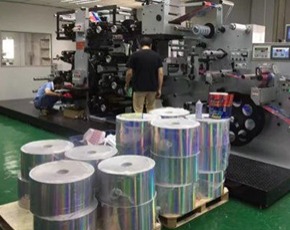
Combining print with a digital layer requires the print steps and the digital steps to be planned together. That is a workflow question as much as a hardware question: a factory already running variable-data printing day to day is set up for the serialization discipline an NFC programme needs on the print side.
Building the Business Case
A defensible business case has four numbers: incremental label cost per unit, the value at risk per counterfeit incident, the expected verification rate, and the cost of the response process. Only the first is a label-supplier number. The other three belong to the brand and its enforcement team, and they should be estimated before the first production run, not after.
Two practical points make the case stronger. First, an NFC program generates scan data, which turns an anti-counterfeiting spend into a supply-chain visibility asset — but only if the data is actually used. Second, the program should have a defined failure path: what happens when a scan fails, who investigates, and how the affected batch is handled. A tag without a failure path is a detection system with no response.
If you are at the point of specifying a program and want printed and digital features compared against your actual pack, request a quote and we will work through the printed label construction and how it pairs with your NFC specification. Start via our contact page, or review the anti-counterfeiting technologies overview and the QR code variable-data labels page before the conversation so the requirements are concrete.
FAQ
Is NFC more secure than a QR code for anti-counterfeiting?
For cloning resistance, yes — a properly implemented NFC tag with cryptographic authentication is substantially harder to copy than a printed QR code, which can be photographed and reprinted. But NFC security depends on the chip's authentication mechanism and a validation backend, not on the fact that it is NFC. A poorly specified NFC tag that only stores a static serial number is closer to a QR code in security terms than most buyers expect.
Do consumers need a special app to read an NFC tag?
On most modern smartphones, no app is required; the phone reads the tag when held close and opens the associated link. Older devices and some regional models may not support it, and users often do not know the tap gesture. That is why NFC is usually paired with a printed QR code rather than replacing it, so every buyer has a scanning route.
When should we choose printed QR instead of NFC?
Choose printed QR when unit cost is sensitive, volumes are high, counterfeit risk is moderate, and you mainly need traceability and consumer engagement. Printed variable data also lets you prove your serialization and data handling before committing to chip costs. Move to NFC — or add it on selected SKUs — when unit value, cloning risk or inspection requirements justify the incremental cost.
Request a Quote
Tell us the label type, size and quantity. Zhao Hua's team replies with construction options, sampling and a volume price.
Request a Quote WhatsApp +86 136 7009 2422