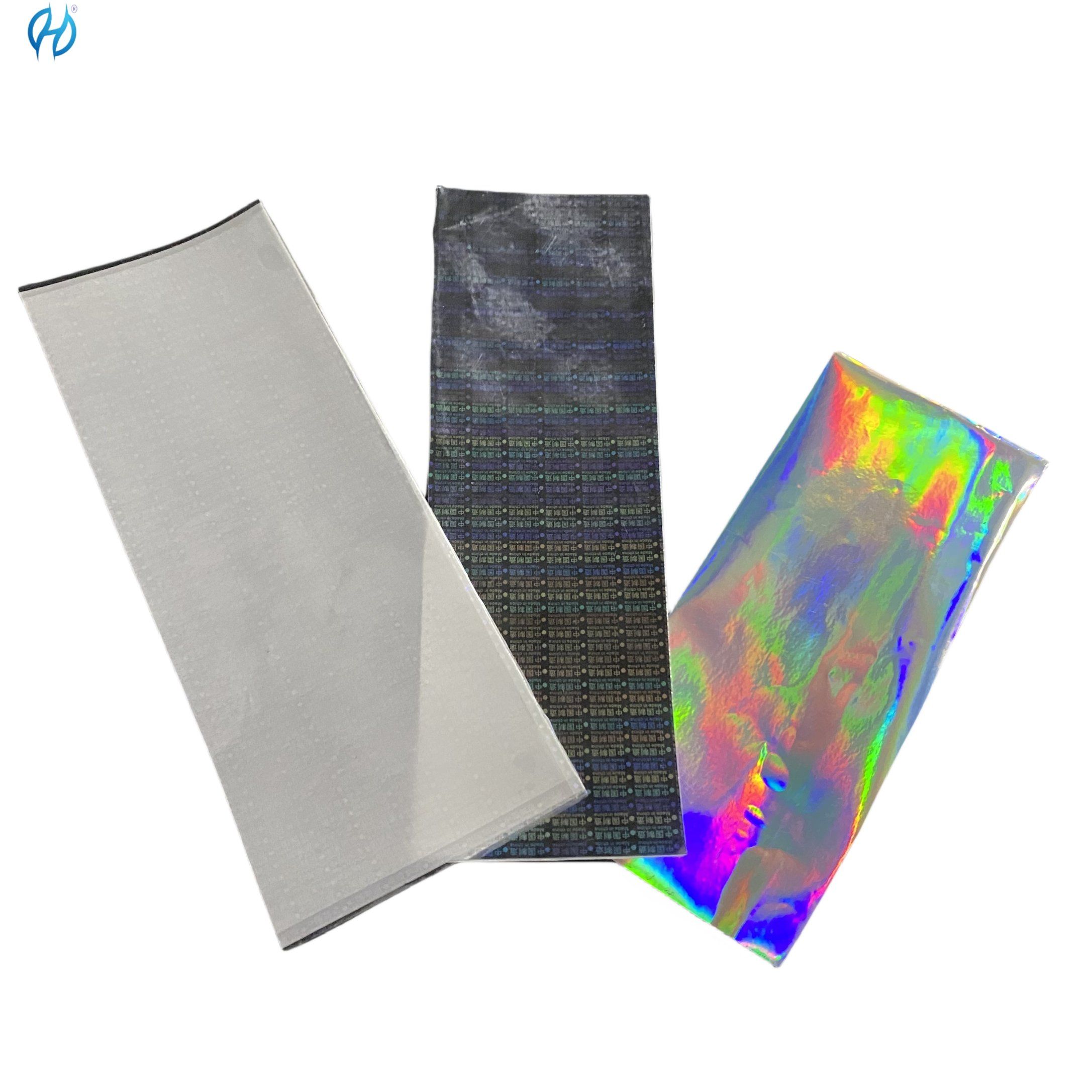
These checks are educational. They describe generic indicators that apply to holographic security labels in general; they are not a statement about any specific brand, product or supplier, and a single failed check should be treated as a reason for closer inspection rather than a final verdict.
Check 1: The Rainbow Effect Looks Blurred or Flat
A genuine hologram is an optical structure, not a printed picture. When you tilt it, the rainbow colours should shift across the surface in a controlled way, and the image should appear to sit behind the surface of the film. A common sign of a fake hologram sticker is a rainbow that looks blurred, muddy or "smeared" across the whole label, or one that barely changes at all when the viewing angle moves. Cheap counterfeits often reproduce a hologram by printing a photograph of one, or by using a low-grade foil that reflects colour but has no real depth.
Hold the label at arm's length under a desk lamp and rotate it slowly through about 45 degrees. Note whether the colour movement follows the design or washes over it indiscriminately. Then bring it closer and look for the next check.
Check 2: No Micro-Text Under Magnification
Real holographic originations usually include micro-text or micro-images that are too small to read with the naked eye. Under a 10x to 30x magnifier, this text should resolve into clean, legible characters or recognisable shapes. On a fake hologram sticker, this area typically shows one of three things: nothing at all, a grey smudge, or pixelated blocks where the counterfeit printer has tried to reproduce fine detail it cannot resolve.
Inspect the edges of the main image and any designated micro-text zone. Good micro-text stays sharp as you adjust focus; poor micro-text breaks up into dots. If you have a reference sample from a trusted production run, compare the two side by side under the same magnification.
Check 3: The Hidden or Latent Image Is Missing
Many security holograms carry a latent image or a hidden feature that only appears at a steep viewing angle or under a specific light orientation. This might be a second image that fades in as you tilt the label, a change in brightness in a defined area, or a pattern that becomes visible only when the light strikes from one side. A counterfeit that has been copied from a photograph will almost always lack this behaviour, because a flat reproduction cannot store the angle-dependent information.
Move the label through a full range of angles, including very steep ones, and watch for any feature that appears and disappears. If the design is supposed to have a latent image and you cannot find it at any angle, treat that as a significant warning sign.
Check 4: The Kinetic Movement Is Wrong
Kinetic effects are the moving elements of a hologram: a repeating pattern that appears to slide, a switch between two images, or a band that travels across the label as it tilts. The key word is *controlled*. Genuine kinetic movement is smooth, predictable and tied to the design; the movement should reverse cleanly when you tilt the label back.
On fake hologram stickers, kinetic effects are often jerky, appear to jump between unrelated images, or move in a direction that does not match the design intent. Some counterfeits show a coarse "flip" between two states with no intermediate transition. Compare the movement against the approved artwork or a known-good sample, and check that the effect appears consistently across every label in the batch rather than only on some.
Check 5: Pixelated or Low-Resolution Origination
Holographic originations are built from precise optical structures, so fine lines, small logos and thin type should stay crisp at high magnification. Pixelation is one of the clearest signs that an image was captured digitally and reprinted rather than originated properly. Look for stair-stepped edges on curves, blocky gradients and a loss of definition in small elements.
This check is best done with a loupe or a low-power microscope. If the supplier has provided a reference sample, inspect the same element on both and compare edge quality. A genuine production run should be consistent from label to label; if some labels are sharp and others are soft, ask why.
Check 6: Poor Registration Between Layers
Many security labels combine a holographic layer with printed information: a serial number, a logo, a batch code or a tamper-evident pattern. Registration is the alignment between those layers. On a well-made label, the print sits precisely where the artwork intends, with consistent margins and no drift across the sheet.
On a fake hologram sticker, registration problems show up as print that wanders relative to the holographic image, uneven borders, or a serial number that overlaps the design. Check several labels from different positions on the sheet, not just the one on top. If the misalignment changes across the sheet, the production process is not under control.
Check 7: A Generic Stock Design Sold Openly Online
One of the simplest checks is also one of the most effective: find out whether the exact design is available as a stock item anyone can buy. If the same hologram pattern is sold openly on marketplaces with no buyer vetting, no unique serialisation and no restriction on quantity, it provides little security value regardless of how good the optical quality is. A counterfeit operation does not need to copy your label if it can simply buy a lookalike.
Ask your supplier how the design is controlled, whether the origination is exclusive, and what prevents the same artwork from being produced for another buyer. For background on how exclusive holographic designs are structured, see our overview of holographic security labels.
Check 8: Adhesive and Edge Quality
The physical construction of the label is part of its security function. Genuine security labels are made to a defined adhesive specification, die-cut cleanly and supplied on a liner that releases predictably. A fake hologram sticker often reveals itself at the edges: ragged die-cutting, adhesive that bleeds beyond the label outline, a liner that tears, or a label that lifts at the corners before it has been applied.
Apply a sample to a clean test surface and try to remove it. Note whether it releases cleanly, leaves adhesive residue, or destroys the label as a tamper-evident product should. Check the edges of unapplied labels under magnification for fraying or inconsistent cuts. If the label is difficult to handle or leaves residue, the construction does not meet the standard you would expect from a controlled production process.
Using the Eight Checks Together
No single check is conclusive. A label can have a convincing rainbow and still fail on micro-text; a sharp origination can sit on poor adhesive. Work through all eight in the same session, record what you observe, and compare results against a retained reference sample from a known production run. If two or more checks fail, escalate before accepting the delivery.
Reference Summary
The table below summarises what to look at and what a good result looks like. It is a field guide, not a specification; your approved artwork and supplier documentation take precedence.
| Item | Detail |
|---|---|
| Rainbow effect | Controlled colour shift tied to the design, image appears to sit behind the surface |
| Micro-text | Legible characters or recognisable shapes at 10x-30x magnification |
| Latent image | Feature appears at steep angle or specific light orientation |
| Kinetic movement | Smooth, predictable, reverses cleanly when tilted back |
| Origination quality | Crisp edges, no stair-stepping or blocky gradients |
| Registration | Print aligned to holographic layer, consistent across the sheet |
| Design control | Not available as an open stock item; origination is exclusive |
| Adhesive and edges | Clean die-cut, defined adhesive, predictable release |
FAQ
How many checks should fail before I reject a batch?
One failed check is enough to pause acceptance and investigate. Some failures, such as missing micro-text or absent latent features, point directly to a reproduction rather than an origination and are difficult to explain as a production variation. Treat two or more failures as a strong indication that the labels should not be used in a security application.
Can I identify a fake hologram sticker from a photograph?
Only in limited cases. A photograph can reveal obvious pixelation or a flat rainbow, but it cannot confirm latent images, kinetic behaviour or adhesive performance. The angle-dependent features that distinguish a genuine hologram from a printed copy require the physical label and a controlled light source. Use photographs for initial screening only.
Does a high-quality fake exist that passes all eight checks?
Skilled counterfeiters can produce labels that pass several checks, which is why design control matters as much as inspection. An exclusive origination, controlled serialisation and a documented supply chain reduce the risk that a convincing copy is available in the first place. Combine the eight checks with questions about how the design is protected.
If you are sourcing holographic laser security labels and want to review origination options, view our holographic laser security labels or request a quote with your artwork, quantity and application details.
Request a Quote
Tell us the label type, size and quantity. Zhao Hua's team replies with construction options, sampling and a volume price.
Request a Quote WhatsApp +86 136 7009 2422